
“beautifully done, but does it work?”
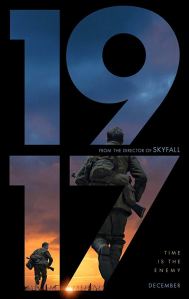
The first thing that catches the eye in 1917 (synopsis, cast & crew, rating, trailer) is the viscerally rendered surroundings – the set design. For example, I don’t think that I have ever seen such realistically looking mud, from so close up. And indeed, the weeks and months spent in freezing, mud- and water-drenched trenches, where one is never dry and always miserable, are a common place of the WWI experience (see the literature of the war poets of WWI).
Then, the next thing that catches the eye is the camera work (cinematography by the great Roger Deakins) – and I am not referring to the much-touted “single, continuing shots,” but to the wonderfully fluid camera movement, that takes the lens along highly improbable and surprising trajectories. One such instant was when it was following the main protagonist (or the one who turned out to be the main protagonist), Schofield, passing the river across the felled bridge – and the camera was floating in parallel with him, hovering, miraculously, fluidly, not too far from the water level – truly a thing of beauty.
However, what starts as a visceral experience, receives a hint of the theatrical, of the artificial, even, later – not in the sense of feeling “fake,” but of feeling “staged” – for us. For example, the ruins of the French town (Écoust) “feel” like they were set up on a stage, or in a studio (which they might have been). On the other hand, on the same set the burning building across that town square gives out just the right impression: you can’t see its features clearly, nor what is beyond it, and you feel lost, because your eyes fail you. (So, even on “staged sets” there are things of beauty.) Also, the way the narrative is constructed feels a bit self-conscious – i.e. with visible intent; I am referring to the way in which moments of “misery” alternate with moments of (intended) “beauty,” or the planned insertion of the “human” (civilian) element (the French woman and the baby), or those soldiers listening in silence to a comrade’s “beautiful” singing – all this feels a bit calculated for effect. And yet, this is based on real stories (as the final credits inform us) told by Sam Mendes’s (the director’s) grandfather – and all that is fine, and all that is to be respected; yet, it sometimes happens that, when you want to tell a story that is important, the weight of its relevance takes over, over its simple humanity – and then it becomes a bit artificial. Of course, I do not know if this is what actually took place – but, as said, at times it feels a bit “designed” for effect; and I was most conscious of it, at times.
The performances are somewhat uneven – although all the players do their job and carry their load well. The choice of a doughy, round-faced boy for one of the two main characters (Dean-Charles Chapman as Lance Corporal Blake) was excellent, as this is what they were, those young soldiers of WWI – farm boys or city lads too young and unprepared for the mechanical carnage of that war. Nonetheless, I was not entirely convinced by Chapman’s performance; especially the death scene was quite underwhelming (although clearly it was meant as a major dramatic point in the film). But perhaps the less than poignant impact of that death has to do with another issue affecting this movie, namely that we should have been more invested, perhaps, in the main characters – by knowing them better, individually, and also in terms of their friendship (relationship). At the end of the movie there is a scene in which Lance Corporal Schofield tells Blake’s brother that his deceased sibling “always told funny stories;” but shouldn’t we have known and discovered this by seeing young Blake doing that, rather than by being told so? In a way, I feel that we the viewers don’t really get to know Corporal Blake, or not well enough – so that we can still receive new information about his character, at the end of the movie. And this is also why his death does not have the impact that Mendes probably intended.
On the other hand, George MacKay (as Corporal Schofield) carries the role and the movie well; his performance is even in the way in which it combines a kind of stoicism and war-weariness, with youthfulness and vulnerability. At the same time, (and this is not his fault), the scene with him climbing over rows of water-filled cadavers, trying to get out of the river, again does not have (what I assume to have been) the intended effect – of disgust, revulsion, maybe even horror, in us, the spectators; somehow it feels just a bit flatter than it should be. And, of course, this moment of “misery” is followed immediately by that “peaceful” moment of “angelic” singing – yes, I do feel a bit manipulated.
But I am afraid that these observations sound all too negative – because this is indeed a beautifully made and very likable movie; and one finds it moving both that it was made, and the intent with which it was made; and, as said, it is a beautifully done piece of cinema. And this is also why I found it a bit frustrating that it fell a bit short of the emotional impact that it actually pursued.
There are some moments with genuine emotional charge – for example, the ending scene, with Schofield looking at pictures of his family, and reading the message from his mother: “Come back to us;” but this moment has been set up earlier, when we learned about his previous (terrible) experiences on the front, and of his reluctance to go home to visit (and why). In other words, the moment with the photos and the message had its desired impact because we have already become involved with Schofield’s personal narrative, at least with regard to this aspect; as said, looking at the overall movie, this emotional investment and engagement does not happen at the level and with the intensity needed, and early enough, so that it could grip and carry us throughout the film, thus allowing for the movie to have its (desired) impact.
But back to the actors’ performances, one should also note some excellent secondary casting choices, with major actors playing smaller – but extremely relevant – parts; and Benedict Cumberbatch, (an unrecognizable) Colin Firth, and Mark Strong all invest their characters with the necessary weight and depth that make those moments of the movie relevant. On the other hand, the character of Lieutenant Leslie (the one who directs them where to cross into no man’s land; played by Andrew Scott), and especially his apparent world-weariness and cynicism, comes across as a bit put on… And this takes me to another thought I had, while looking at the faces of these young actors – especially the extras; namely, to what degree are these contemporary young people able to understand and to portray the depth and the impact of the misery and carnage of the First World War? Aren’t those experiences just so remote from their daily experiences, so as to be almost incomprehensible – and thus untranslatable? What is the role of the director, and what can he do, to immerse them into that state of mind and of being, to facilitate that understanding (beyond what is the task and devotion of each individual actor; but what if they don’t or can’t do it)? Because I was looking at them, and at their faces, and I kept seeing them at a club, or browsing on social media, or being taken by their to tennis classes… There is a tremendous gap between the existential level at which a young person’s life happens today, in the West, in an urban / suburban environment – and even life on a farm. today – let alone the experience of World War I. But perhaps all this is only in my head – or is it? After all, isn’t the task of the actor, always and forever, to immerse themselves into lives (and times) that are not their own – and isn’t it part of the very work of the actor to find the ways for doing so? And that takes us back to the question of the role of the director, in facilitating this, in preparing them – as much as he can – for this. But, yet again, these might just reflect my own prejudices regarding these young actors’ life experiences; who knows?
Overall, then, does the movie work? To address this question, at the end of the film I asked myself what was in fact the point (the goal) of the movie. Clearly, it was to relate some stories of personal import for Sam Mendes, stories that originated from the lived experience of those moments and times. From that point of view, the movie is worthy of respect, appreciation, and empathetic response – and it has them all, from me. Then, the movie probably wants to share this experience (these experiences, of those young men – or heroes – of World War I) with us as well. In the UK World War I has a very special place in the public consciousness and (official) memory – and the movie seems to respond and to talk to that shared understanding of the Great War – somewhat like the red poppies worn in Britain by all the public persons on Remembrance Day. But just like that very public gesture, as respect- and note-worthy as it is (and it is indeed), I wonder if the real, human-level impact and experience of the actual events are not a bit lost, or submerged, under the public nature of the gesture. As said, sometimes the outward “importance” of a thing can overwhelm the real, lived, experienced – human – reality of said thing.
The film also works as a sort of road-movie, taking us through slices of the frontline experience; objectively, it does that well; but, again, are we really “touched” by all that we encounter and see in the movie? So, overall, does it work?
The movie that comes to mind immediately, for comparison’s sake, is Gallipoli; in fact, the moment I learned about 1917 and about its plot, my thoughts went immediately to that movie. So, let’s briefly compare the two – although I am well aware of the fact that they are two distinct and self-standing works, worthy of being judged on their own merits; still, we might learn something from this comparison. Well, given the superficial similarity of the story (and of the setting), what sets Gallipoli apart – not only from 1917, but also as one of the most memorable war movies ever made – is its emotional impact, and the way in which it conveys the inherent absurdity of war. The emotional impact of Gallipoli is clearly due to the fact that it spends a lot of time introducing us to the main characters, that we get to know them well, in all their rambunctious and promise-filled youthfulness – and thus, whatever happens to them, touches us personally. Secondarily, the movie chooses its topic very precisely and intently; it is about an especially absurd and tragic moment, so its goal of revealing the senselessness and tragedy of war is perfectly served by its choice of topic. Thus, the impact is double, in Gallipoli – both emotional (personal) and existential (helping us to understand, by experiencing – and thus to grow); and the movie is also carried by some excellent performances, which help to counterpose the inherent naivety and hopefulness of youth, with the senselessness and the death-filled nature of war. Overall, then, Gallipoli has a true impact on the viewer; for example, although I have not seen it in a long time, I have never forgotten it, and I am ready to watch it again.
Let’s conclude by saying that I am somewhat afraid that these thoughts on 1917 might come across as too negative – when it is in fact a beautiful movie, that deserves (and earns from me) empathetic respect and genuine feelings of appreciation. However, I do think that the questions raised above are worthy of being discussed, first of all because they are the ones that dominated my thoughts, after watching the movie (and thus I wanted to answer them, for myself), and secondarily because I think that they might help us better understand what makes a movie work, and why.
In any case, I am thankful and appreciative for having watched 1917 (directed and written by Sam Mendes, and shot by Roger Deakins).
 AFTERFILM
I agree. Especially about the “designed for effect” bit. Some of the scenes (yes that corpses in the water business) were highly predictable and felt included more to say “hey, we’re in WW1 here” than to further the story at all. It was a decent journey story – though not a great one. Which, of course, begs the question “what makes a great journey story?” I’ll try to blog on that myself when I review this flick, too. Thanks for the read.
LikeLike
Yes, there is a hint of artificiality to the proceedings, at times – but the intentions were genuine – and it was this contrast that I noticed. Because, as I have noticed it (on) myself, as well – when something is tremendously important, the importance of the thing can create a kind of anxiety, which can make us find refuge in clichés, which provide some (internal) stability and comfort, but which also take away from the originality and the authenticity of the artistic expression.
LikeLike