Once Upon a Time… in Hollywood (2019)

“grand cinema – and an ode to classic Hollywood”
Once_Upon_a_Time_in_Hollywood_poster

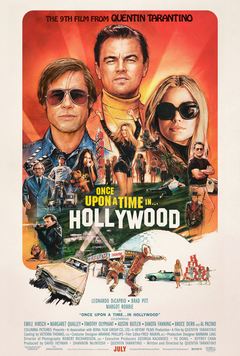
Quentin Tarantino’s Once Upon a Time… in Hollywood (synopsis, trailer, cast & crew, rating) is a most pleasurable fare; it might just be my favorite Tarantino movie, or at least ranking at the same level as Pulp Fiction (or Reservoir Dogs), while being quite different from those. But what makes it so appealing?

First of all, its atmosphere. Clearly the intention was to capture and to reproduce a specific time and place: the classic Hollywood of the 1960s (the end of an era, and the transition into a new era – from the TV and films of the 50s and of the 60s, into the culturally very different decades of the 70s – and of the 80s). In the process of reconstructing this world – which Tarantino does, clearly, with care and affection – the movie also reproduces what could be best expressed as “Americana” – or, “Californiana” (for many around the world, the image of California, especially as learned from the movies, is emblematic for what and how the US is supposed to be). It is a sunny, affectionate, but also in many ways blunt reproduction of a world (or of several worlds: of movie and TV production, of working actors, of “civilians” living in Hollywood, of rich people, and of decrepit people). But it all revolves, of course, around the world of film, of movie-making.

That, indeed, is the center of Hollywood (or used to be), so we encounter and see people living at various degrees of closeness or distance from that center: from the up-and-coming starlet (Sharon Tate); to the actor anxiously negotiating the transition of the industry, and of himself, from the 60s into the 70s, who is worried about his future (Rick Dalton); to the crew (stuntman Cliff Booth, who lives “around” Dalton); to the child actress who exhibits an endearing seriousness about the craft, but also an understandable naivety about the working life of an actor; and even to the young girls of the hippy/cult commune of Charles Manson (who live from the crumbs of Hollywood, literally and figuratively, as they take tourists to famous people’s houses, and also pick through garbage containers). In the middle of the narrative, traversing it and giving it direction, are the two parallel stories of Dalton and of Tate (who also “happen” to be neighbors) – which is a good vehicle to showing us the everydays of the actors’ lives – their highs, and their lows; from partying, to doubt and agony about their career or their craft; from being on the way up, to being – or being afraid of being – on the way out etc. One could (and probably should) also add here the Booth storyline – but one can also qualify it as a “satellite” narrative, around and along that of Dalton.

(Speaking of Cliff Booth, and of living on the fringes of Hollywood, it is symbolic how Booth, who is formally Dalton’s stuntman and double, but nowadays works for him as his daily factotum and amigo, and who thus spends his days within the gravitational pull of Rick’s career and life – how he at night goes home to a trailer parked somewhere on a lot behind an open air cinema.)

And this Hollywood – and, in fact, this entire world – is depicted as having two opposite but complementary sides: the glamorous, seductive, fleetingly attractive one, and the dark, dangerous one, of human misery, of evil. This duality characterizes the entire movie – see the apparently fresh young things of the hippy / cult commune (e.g. Pussycat): at first sight alluring and attractive, with the promise of youth and beauty, and quickly turning into something much more dubious, ugly, scary even (the scene of Pussycat climbing unto that car and yelling and gesturing at Booth, after having been so friendly and behaving even childishly toward him, is a perfect expression of that flip of a coin; or see the appallingly dirty, unkept conditions inside Spahn’s home; not to mention the really troubling scenes at the end, when these “freedom-and-lovey” hippies are getting ready to kill.)

(As a side-note, this is the same duality that one sees and perceives in Vegas, or in Atlantic City – one just has to step off the main strip, to see the undergirth, the seamy underbelly, of the glittering surface; all those “occupations” and endeavors that grow like a dark fungus around and under money, fame, appearances.)

But back to our initial question – why did I find this movie attractive, pleasurable? Besides the atmosphere (the Hollywood of the 60s), which is so well captured, the film is also very well (and thus enjoyably) structured. As said, the main thread goes along two (three) parallel narratives, of Dalton (and Booth) and of Tate, and that constitutes, as it were, the middle of the movie; which is preceded by an aesthetic-emotional and informative introduction into the world and the momentary status of each of these characters; and is followed and concluded by a coda about their paths, which itself ends with an egregious (but also egregiously enjoyable) finale.

Speaking of the finale – when I first saw the movie, the ending was definitely not what, or how, I expected it to be. Not having read much about the details of the plot of this movie (I never do), I still knew that it featured or made reference to Sharon Tate (who, as is well known, was brutally murdered – in real life – by Manson’s followers). Knowing that much about the movie, while I was watching it for the first time I kept getting tense and nervous, at various moments throughout the film, when I expected – every moment now! – for something bad to happen, for violence to erupt; in a way, the threat of evil hung above the movie throughout, during the first watching (such a tense, expectant moment in the movie was when Booth visited the hippy/Manson farm). And yet, nothing happens… well, not until the end.

Speaking of the ending, then, I must say that, when I first watched the movie, I found it somewhat disappointing, or underwhelming, simply because I could not make sense of why Tarantino had chosen to deviate from the historical facts. I simply could not understand the reasoning behind the choice (although one could say that it is a metaphor for Tarantino “saving” that classical Hollywood that he lovingly recreates and displays in this movie – but I am not terribly interested in metaphorical explanations.) When watching the movie the second time, however, since I no longer expected that the actual, historically accurate story of Sharon Tate would be depicted (at least in its actual denouement), and since I was thus freed from the ongoing tension of not knowing when evil would break through, and when violence would erupt, I was also able to watch the ending in a more detached state, and to find satisfaction in it. Mind you, even when watching it the first time, I found that concluding festival of violence (oddly) satisfying and rewarding (perhaps also as a much deserved comeuppance for those evil hippy/cult members).

Except, perhaps, for that rather prolonged shot of the carbonized body of the woman in the pool – and not because I was in any way repulsed by that image – by no means; to the contrary, I found that lingering on it actually took away from the “realism,” and thus from the impact, of those scenes of violence. and that it took us out of the moment, at least to a degree. And this takes us to another aspect that I would like to note, regarding this movie – namely, a certain degree (or a streak) of self-indulgence, which I have noticed in other Tarantino films, as well, after the great successes with Reservoir Dogs and Pulp Fiction; and which I also noticed, for example, in Martin Scorsese’s The Irishman, as well (another great movie, by the way). What is all this about? Well, it seems that once the “general verdict” about a director (or about an artist, in general) is that they are a “genius,” or something “extraordinary” – and once, as a result of that, they are put on a sort of pedestal, being given (to a large degree) free rein, and being thus excluded or sheltered from the grind of the daily negotiations with the studio or with the producers, or from having to cope with very tight limits of time and budget – it seems that, once all these happen, what also comes with this is a certain slackening of artistic self-discipline, on the part of said artist.

This can manifest itself in various ways – for example, in this movie I would classify under such a heading the random use of indicative or explanatory text on the screen – random, because it happens in fact only two times: in the scene with Steve McQueen, at the party, and in the one with the car jumping between the two elevated ends of a bridge, while filming that Italian mock-Bond movie. Now, why use these superscripts? Why introduce them, randomly, and only in those two moments? In other words, if the use of such text would be an integral part of the “language” and visual style of this movie (like, for example, the trippy multicolored images interspersed in Punch Drunk Love, or the silent film-like intertitles in The Sensation of Sight), then nobody would mind; but doing something just because one is able to do, even if it comes across as incongruous with the overall tone or style of the movie – well, that I would classify as self-indulgent.

But this is not a new issue, or question, for art and the artists; namely, what is best, for the artist to have complete free rein, or for him to have to deal, and thus to enter into a conversation, with certain limits (which can be limits of style, as in certain “formal rules;” or of means at one’s disposal, or of time etc.). There is the Romantic (uppercase, as in the historical current) notion of the artist soaring unencumbered, as being the best and most desirable state and condition, as he then can attain to the highest realms of aesthetics and of truth. Appealing image, which is also related to another underlying modern idea, that freedom is a value in itself – instead of being only a condition, that gives us the possibility of choice – a choice that can be good, bad, at least imperfect etc. After all, in this very movie aren’t the young hippies of the Manson commune “free,” practicing free living and free loving – and yet their “free choice” turns out to be for deepest, darkest evil?

Without going too far away from our discussion of the movie, one should remember that all (or at least, the overwhelming majority) of Michelangelo Buonarotti’s works were commissions – where he was given a clear task, a certain “surface” or location, and a fairly clear commission – within which he then was able to manifest his soaring creativity and, in fact, genius. But am I arguing for the necessity of outer constraints, of having to fight with obtuse studio executives, and so on? No, never. But I am arguing for the necessity of inner constraints, by which I simply mean an inner artistic discipline, which translates into a certain unity of style, into a coherent artistic language. And sometimes the need to engage a fixed outer framework (necessities and constraints) – be it only in terms of money and of time – helps develop that internal discipline, which results in a more aesthetically balanced and harmonious artistic act. In other words, just because one may use free rhyme (which I actually prefer, or at least I delight in), does not mean that, automatically, his poems will actually have a higher artistic value.

But back to our movie; other instances which I would identify as manifestations of a similar lack of aesthetic self-discipline (i.e. coherence), would be, for example, the overly long scene of Dalton filming a Western; the same thing could have been achieved in a much more concentrated and focused (yet not rushed) manner. Or even the fact that Kurt Russell (who also plays a character in the movie) narrates, here and there, parts of the movie; why Russell? Clearly, it is not the character whom he plays in the movie who actually does the narrating – or is it? So why confuse the planes? And why narrate only at certain (random?) moments, and not more consistently, throughout the film? Again, this – and similar instances – feel like moments of decision which went broadly along the lines of “I can do it, so I’ll do it.” And this is where the studio guy (not that I like them, or want them to meddle – but just as an example) would come in at the end of the day, see the rushes (or check later on the editing process), and ask – why? Or someone, anyone, would ask, why?

Because another problem with artists being put on a pedestal, and receiving, as it were, a sort of a carte blanche, is that the critics as well tend to be possessed by a sort of a feeling of inferiority toward these declared geniuses, so that when they see something that they do not understand, they feel that it is probably their fault (or at least, that it is gauche) that they do not understand, and thus will not question the artist’s choice (and thus would not begin a dialogue that might just help clarify and thus elevate the artist’s own craft). (Not that I am on the “side” of the critics, generally speaking; if anything, you will find me on the side of the artist, most of the time, almost always; but this is a question, as said, of actually helping the artist develop and practice a coherent aesthetics – which is what, I guess, I am half-reproaching, or at least bringing up, when talking about this so-called self-indulgent moments, in the later works of people like Tarantino or Scorsese). But enough of this: I did not bring up these aspects because they would be crucially important aspects of the film – in fact, these are relatively minor, and clearly not decisive, details; I just enjoy such occasions of picking up on issues that can then lead to broader discussions about the condition and the craft of the artist; so this is what this was, a useful divagation – accompanied by a relatively small criticism.

But speaking of criticisms – another aspect that I did not fully understand, nor entirely appreciate – was the way in which scenes from movies and TV shows “of the 60s” (real or imagined) were (re)created and integrated in this movie. First of all, Tarantino used a variety of means for doing that – he either shot a whole scene (or set of scenes) for an imaginary 60s TV show, or he used CGI to replace the original actor with DiCaprio, within real footage from a real ‘60s film. However, the quality (or the style) of these efforts was uneven – compare the less-than-convincing footage with DiCaprio in The Great Escape, replacing Steve McQueen, with that of Leo in the FBI TV show (of course, this might be a conscious choice, as the first one was Dalton imagining himself playing the role in The Great Escape, while the second was a show in which Dalton “actually appeared”). But, more importantly, I would mention here the different “western TV show” scenes filmed by Tarantino, which did not come across as entirely veracious, for me, not because of anything having to do with the set design or other externalities (of course not), but mostly because the actors themselves did not behave (read: act) in that same mannered, formalized, even somehow uncanny way that was characteristic for the acting style of that age, in those movies and TV shows. My point here is not about “mistakes” or “faults” – but about questioning the reasoning behind these choices. In other words, if Tarantino wanted to actually recreate (“with his own hands”) mock-60s westerns – then do it all the way, paying attention to every little detail, and being faithful to a T! And, if you want to insert current actors into old footage – then do it in the same way, whether ultra-realistically, or with some inherent awkwardness – it does not matter, but let the efforts be coherent. Otherwise, I simply do not understand these variations in approach or quality – are they accidental, or are they intended – and, if so, why? I guess that the issue here is not about the actual choice – of doing it this way, or that way; but, again, of using a coherent and unified style and cinematic “language.”

But, although I seem to have spent long paragraphs on these “qualms” – these are, in fact, minor issues, which I see worthy of discussing only (or mostly) because they allow me to raise broader questions of aesthetics and style. Overall, these do not affect in a notable way the overwhelmingly positive qualities of this movie.

And now on to the next issue – let’s talk a bit about the acting in this movie. I must confess that I found Leo DiCaprio’s work in this movie quite excellent, as he created a character – and embodied a person – that was truly different: somewhat rough, and somewhat of a simpleton; anxious, but also arrogant; rich but afraid – it was all good. Margot Robbie as Sharon Tate was exquisitely delightful, as well – a masterclass in showing that you do not need to talk, in order to act – what you need to do is be; yes, most enjoyable. And this takes us to Brad Pitt – who has recently received several accolades (awards) for his work in this movie, but by whose performance I must confess that I was in no way impressed. Not that he did anything wrong – to the contrary, he carried the role very well, did a perfectly fine job; but, for me, nothing that he did was in any remarkable way different or “other” from previous Brad Pitt characters and personae. This is why I emphasized the fact that DiCaprio embodied a character who was markedly different – both from him, and from his previous roles (in my estimation). For me, DiCaprio was the stand-out – and Robbie – in a field of otherwise uniformly superior performances (including that of Brad Pitt). I just don’t see why all the accolades (unless they were conferred for his overall acting career – as it often happens). Finally, it was also good to see Al Pacino doing a very different character himself (a small-ish, but impactful and delightful part); and I also found the presence of, and the scenes with, “Bruce Lee” (played by Mike Moh), funny and refreshing.

Speaking of Bruce Lee, in the tagline to this discussion I mentioned that this film is “an ode to classic Hollywood;” yes, but in a broad sense – that includes movie-making, but also the TV shows of the 50s and the 60s; and the (then) newly-arrived Asian martial arts genre; and the fascinating world of Italian spaghetti westerns (and spaghetti movies in general). All these styles and “worlds” have been, of course, perennial points of reference and personal favorites of Tarantino himself… And this is how and why this film is quite the personal paean to movies – to cinema – to the medium and world of film, itself. An imaginary story about a medium that is, essentially, imagination made visible and real.

I also mentioned earlier that this movie has become one of my favorites – if not my absolute favorite – of Tarantino’s body of work. I am using the word ”favorite” consciously, because it implies a subjective relationship with the movie – which would be accurate, as I find myself “liking’ this movie, in the sense of a personal attraction and enjoyment which is not the same with the somewhat cooler (in both senses) and more intellectual enjoyment of (and admiration for) Pulp Fiction (or Reservoir Dogs). In other words, this movie appeals to my aesthetic and personal leanings, in ways in which the other two do not. And why is that? Well, perhaps because of the actual world it describes – of the classic America of the 60s and 70s; of sunny California – that is, Hollywood etc. It turns out that I might have if not similar, then at least parallel warm feelings towards these times and images (toward this Americana), as Tarantino has. So, the coupé driving down a Hollywood boulevard, on that street lined with classic American neon signs, under a blue or dusky, ink-colored California sky, with palm trees (which, if they’re not seen, are felt) – well, aesthetically and personally, I find all this very appealing.

(We do like movies because we do like to dream. There’s an inherent romanticism – lowercase – in the medium of cinema; even if it depicts the most terrible events.)

Overall, therefore, Once Upon a Time… in Hollywood was a most pleasant experience, and a movie that I thoroughly appreciated, on several levels.

***

Footnoted minutia: for some reason (but I wonder why?) this movie was banned in China (!). Well, discuss among yourselves.
The Silence (1963)

“or, the lack of communication”

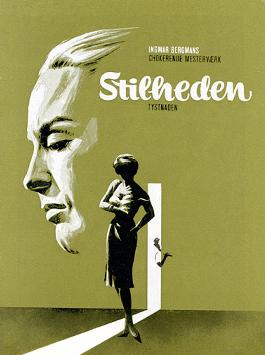
The silence film_posterTogether with Through a Glass Darkly and Winter Light, The Silence (synopsis, trailer, cast & crew, rating) is part of Ingmar Bergman’s trilogy dealing with (or, rather, inquiring or searching into) issues of faith and of God. Formally, this is relevant information – but we better look at the movie itself.
The first question that emerges is how one should approach (or “read”) this movie. Is it a poetic, lyrical piece – in which case one lets the images and actions on the screen act upon one’s sensitivity, emotions, imagination – or is it a narrative (prose, prosaic) work, in which case one struggles to understand what exactly is happening or has happened, what are they doing and why etc. I found that for me the lyrical-poetic approach works best with this movie.

I should also note that, before watching the film, I read the script that Ingmar Bergman wrote for it (he is the writer and director of this trilogy, so these are the personal works of an auteur). Based on that, I can say that The Silence works better “as” a film, with moving images and sound, rather than as a text. I say this, because that is not necessarily the case with the other two films (and especially Through a Glass Darkly). But this movie’s title is The Silence, and it helps to be able to hear that silence – or, for example, the unintelligible noise that is a stand-in for silence, or for lack of comprehension, or for incommunicability.

Approaching then the movie as a poetic work (which means that one is less interested in what exactly took place, and when, and by whom – than in perceiving aspects and states of existence), the main impression conveyed (and perceived) is that the principal theme of the film is the lack (or even impossibility) of communication, in the broadest sense. This can be conveyed, indeed, by a noisy street, where the white noise of the daily hustle and bustle combines with the strident, cacophonic noise of the cars and of the street vendors. It can also mean actual lack of communication – or impossibility thereof – as between the two sisters (the movie’s three main characters are a younger sister and her child, and an older sister, who travel through a non-descript, foreign country, and stop at a hotel – while one of the sisters is ill, even dying). Incapacity of communication: the entire story takes place in a foreign, even alien country, whose language and habits are different and themselves “foreign”. And also to the same issue of the lack or impossibility of communication pertains the sexual behavior depicted on the screen (from vain attempts at self-love, to casual, purely physical sex. All these are examples or manifestations of said lack of communication with other human beings – and, more deeply, of a breakdown of human relationships.

And this lack of communication – “supported”, as it is. by sentiments of hatred or resentment –  seems to be a symptom or manifestation of a deeper problem – of a lack of love and of faith. One of the characters had a fleeting sexual encounter (or so she says) behind the colonnades, in a church; what better image for replacing divine love with an unfruitful attempt at self-satisfaction?

(Speaking of these sexual dimensions, I noticed that for some critics or spectators this is the main, most remarked on, trait of the movie. For myself, I found that these aspects, although more directly depicted than in other movies of that era, are nevertheless filtered through an artistic lens – and, yes, it matters if one is able to take them as metaphors for something else (as I am), or simply as acts or actions. But for more info on this, see the movie’s rating.)

Lack of love, then – of affection, of relationship, of the possibility of relationship… but why? I don’t know – or, rather, Bergman hints at some of life’s obstacles to forming and keeping relationships (which I will discuss in a second) – but mostly, it seems that the underlying cause is the fact that these characters (and possibly Bergman himself, in his mid-twentieth century Sweden or Western Europe) inhabit a world that has been voided of God, faith, love, sense. An emptied world, in that sense – and yet the yearning (which is deepest in the human being) for love, remains and thus destroys (most of) these characters. But let’s not get too far off from the film itself, with our interpretations.

As said, Bergman – or, rather, his characters – hints at some of the obstacles to relationships; some of these have to do with all that accumulation of dirt, hurt, of incomprehensible inner impulses and emotions, of a relationship’s historical memory – all that is, let’s say, visceral and murky… And this takes me to one of the major strengths and points of attraction for me, with regard to Bergman’s films, which is his capacity to depict the cellular-level tissue of existence, of life – those inexpressible and un-conceptualizable strata of ourselves and of our existence that form the mundane soil of our everyday life. “Depict”, I say, because they need to be “depicted,” for example on the screen – because they cannot be “said,” expressed, through words (hence incommunicability). (But poetry is born as the artform specifically suited to express these ineffables of existence.) So these “interstices” of existence are very much present and depicted in Bergman’s films – while, at the same time, they are mostly lacking in the typical Hollywood movies (which is why, perhaps, both characters and actions in these movies tend to come across as unidimensional  – because, more often than not, both characters and actions in these moves are sublimated into clear, univocal acts or traits – but that is not truthful, because we, as humans, as not unidimensional, are more complex, and not all is expressible in words; and thus we find that these movies are ultimately unsatisfying, and even feel a bit fake – unless one gets too accustomed to them).

Parenthesis: on the other hand, while this is a strength in Bergman’s movies (or so I find), and in other movies of this kind, there might also be an inherent danger in this exploration of the murky interstices of mundanity. After all, there is such a thing as a “micro infinity” – namely, dissecting physical existence into smaller and smaller sub-atomic dimensions – there is no end to that. Similarly, one could get lost – theoretically – in going deeper and deeper into the murky and confusing interstices of existence; there is that danger, as well. I am not suggesting that Bergman engages in that; I was just pondering on the right authorial strategy: without the complexity of existence, and our confusing and incomprehensible parts, life depicted appears fake; but prudence is needed, as the goal– for me – is realistic depiction of the truth of existence, and not a hubristic attempt at all-comprehension, or a wallowing in the layers of the soil of mundane life.

Another strength of Bergman’s movies (presumably related to the first) is his ability to construct and to depict real human relationships– as they are. This is why his Scenes from a Marriage (the film from 1973) is one of my favorite movies on the theme.

But back to the topic that we were discussing, of the obstacles to communication (and to relationships). Ester, the older (and ill) sister seems to refer to these accumulated obstacles, when she talks about the fact that “you need to watch your step among all the ghosts and memories”; or, talking of “[t]he forces [that] are too strong… the horrible forces”; or even of the off-putting “erections and secretions” (the viscous physicality of existence). Indeed, (helped by their acting) we perceive that in-between the sisters there is an entire past, with so many contradictory events, emotions, hurts, reactions etc., and that it is inexpressible, unclarifiable, unsolvable – and that this past is part of the reason why they can not communicate (or have a functional relationship); other reasons are implied as well. These accumulations of the past might also be responsible for the fluctuating behavior of the two women – for example, in how they relate to other people (Anna, the younger sister, alternates between being overly affectionate, or quite cold and rejective, toward her son, Johan).

We were saying that the movie is, or seems to be, about the lack of communication, and the lack of faith and of love. Let’s add here – as it is related – that in the film there is also a sense of a world that is alien, unknown/unknowable, and frightful; see the “war” themes in the movie (the trains carrying tanks, the warplanes’ flight over the city, the rumbling and then menacing apparition of a tank, on the street, in the night; the soldiers in the café – and so on); the presence of war, in other words, somberly and mutely threatening. Or the theme of the hotel, as explored by the young boy, Johan.

Here I should remark – in connection with what was said beforehand – that Bergman does a swell job in depicting the way in which a child sees or experiences the “wide world” – from the intimidating encounter with sickness or death, or with conflicts between the adults, to the incomprehensible behavior of your parent, to the strangeness of large, impersonal buildings (to be explored, but also threatening), to meeting strange strangers who speak in strange tongues about foreign things – in other words, the way in which for a child sees the things of the world of the adults, and of the world “at large,” as it were. In this movie, the child who experiences these is Johan – and his experiences represent another manifestation or expression of that incommunicability and incomprehension that I see as the central themes of the film. (And I was wondering, while watching Johan and his adventures – is this child Bergman? or is he us – versus the world? Or, even, is this a reference to some actual childhood experiences or memories of the auteur?)

There is a moment in the film when Johan, the boy, “stages” a marionette play (Punch & Judy type) for his ill aunt, Ester. It is the shortest play, because it quickly devolves into Punch “punching” Judy, while shouting incomprehensible things in a made-up language. When asked what this is about, Johan responds that Punch “is scared, so he speaks in a strange language” (and also erupts into violence toward his mate). Quite a clear hint at an interpretive key for the movie. Our existential anxiety – in a world that seems alien and emptied of meaning – also manifests itself as fear and through hurting others – and ourselves. This, of course, if this is in fact the world; but is this our world, my world? In any case, it is the world proposed and depicted by Bergman in this movie; and this might just be him pulling the alarm about, and critiquing, or even diagnosing, Western or Swedish society around the middle of the twentieth century. (But we are getting again pretty far from the film itself.)

The movie ends with Ester, the older one, drawing some conclusions about life and about herself, while she is agonizing in what is probably her deathbed (in her hotel bed). Johan and his mother, Anna, leave to continue their journey toward home, toward Sweden – but not before Ester starts writing, and then gives to Johan to take with him, a sort of embryonic “dictionary” of the language spoken in this foreign country; for example, what are their words for “hand”, “music” etc. She tells Johan – or us, the spectators, I am not sure right now – that he will discover later how important this is; this, what? Well, I assume, a dictionary means to have the words, to understand, to be able to communicate – to have a gateway into existence. Communication, as the entry point into relationships – and thus, to love and meaning (and, why not, faith).

One should also add here that the sole thing that constitutes a point of mutual comprehension and reciprocal communication between these Swedish guests and the locals (in this alien country), is music (either as Bach works played on radio, or as the words “Bach” and “music”, which turn out to be the same in both languages). Music, as an aesthetic alleviator of aloneness, alienation, incommunicability – and lack of meaning.

Yes, one could easily take this movie as a critique (or critical depiction) of a certain society – or of a certain mode of existing. Since a poem is a self-enclosed something, a universe unto itself, self-sufficient, so this movie (and films such as this) can work by depicting “one type” of world, or “one type” of existence (which might not represent the entirety of existence, or of the human possibilities). But a poem is an accentuated, hyper-sensitive depiction of one thing, of one aspect – that faces us with that aspect; in other words, most poems are not encyclopedias, intending to explain all of existence. But, by facing us with the “concentrated” version of one aspect (or type) of existence, it can force us to take it seriously, and thus to make a decision, about and for ourselves, about that specific issue. For example, we can leave this film (or the poem) with the impulse of thinking about how we can best avoid, or avoid falling into, such an empty existence – both as individuals, and as a society. A poem can thus function as a via negativa, revealing something (e.g. need for love or for meaning) by illustrating its absence. And this might be the way in which The Silence becomes part of the Bergmanian trilogy on God (or lack of, or search for God), on faith – and on existence in the 20th century.

I will conclude by saying that I am afraid that due to this discussion, and to the themes we covered, the movie might come across for you as gloomy and…; while in fact I left this film – as it usually happens with Bergman’s movies – energized and engaged; and I assume that this has to do with the cathartic effect that true artworks have on us (see the Greek tragedies’ effect on their contemporary spectators) – namely, artworks that speak to us by touching on aspects of the truth of reality, of existence; yes, there is something very rewarding and moving when one encounters real communication about real things (even if that thing is “the lack of communication in a God-less, and thus sense- and love-less, world”).

I mentioned at the beginning of this discussion (and I promise that this is its last remark) that my approach to and “reading” of this movie was poetic, lyrical; letting the images and sounds, the humans’ actions, the emotions depicted, enact their effects on my capacities of perception and feeling (just like I would do with a poem or a painting). And I think that that was a good choice, because I dare say that, taken purely prosaically, this movie would not “work” – i.e. if one would approach it very prosaically, as a puzzle to be solved (who does what, when, why, and what is the conclusion). There are too many gaps in information for the movie to work in that sense – and it would soon become frustrating, or unrealistic (un-pragmatic), in that case. And here we arrive at the criticism often raised against so-called art(sy) movies – regarding their incomprehensibility, pretentiousness, remoteness from everyday experience (and the everyday viewer). Well, if a movie is “artsy” and only artsy, (for artsiness’ sake), then I am fully on board with rejecting such snobbish and pretentious nonsense. However, in my reading, this is not that. But does it have moments when there is a slight hint at pretentiousness, at a certain abstracted mannerism? Perhaps, a few; for example, I found Gunnel Lindblom’s writhing in bed, as she was alternating between hysterical crying and manic laughter, pretentious, mannered and unnecessary.

But I am certain (and I am not the only one) that this movie is not intended simply as a pragmatic narrative  – it is designed to appeal to our poetic sensibilities; it wants us to feel, to perceive, and thus to understand existentially – or, as I said, poetically. So, I left this movie engaged and replenished with thoughts and feelings about true, real, existential things – thus a rewarding experience. However, I will note that of the three films in the trilogy, Through a Glass Darkly, Winter Light, and The Silence – all of which I appreciate and I have enjoyed – this might be my least favorite (and yet still an engrossing and rewarding experience, and a movie that I would recommend, for those interested in such fare).


1917 (2019)

“beautifully done, but does it work?”

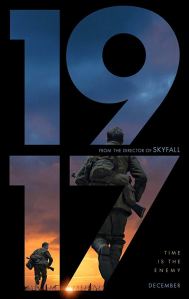
1917 poster

The first thing that catches the eye in 1917 (synopsis, cast & crew, rating, trailer) is the viscerally rendered surroundings – the set design. For example, I don’t think that I have ever seen such realistically looking mud, from so close up. And indeed, the weeks and months spent in freezing, mud- and water-drenched trenches, where one is never dry and always miserable, are a common place of the WWI experience (see the literature of the war poets of WWI).

Then, the next thing that catches the eye is the camera work (cinematography by the great Roger Deakins) – and I am not referring to the much-touted “single, continuing shots,” but to the wonderfully fluid camera movement, that takes the lens along highly improbable and surprising trajectories. One such instant was when it was following the main protagonist (or the one who turned out to be the main protagonist), Schofield, passing the river across the felled bridge – and the camera was floating in parallel with him, hovering, miraculously, fluidly, not too far from the water level – truly a thing of beauty.

However, what starts as a visceral experience, receives a hint of the theatrical, of the artificial, even, later – not in the sense of feeling “fake,” but of feeling “staged” – for us. For example, the ruins of the French town (Écoust) “feel” like they were set up on a stage, or in a studio (which they might have been). On the other hand, on the same set the burning building across that town square gives out just the right impression: you can’t see its features clearly, nor what is beyond it, and you feel lost, because your eyes fail you. (So, even on “staged sets” there are things of beauty.) Also, the way the narrative is constructed feels a bit self-conscious – i.e. with visible intent; I am referring to the way in which moments of “misery” alternate with moments of (intended) “beauty,” or the planned insertion of the “human” (civilian) element (the French woman and the baby), or those soldiers listening in silence to a comrade’s “beautiful” singing – all this feels a bit calculated for effect. And yet, this is based on real stories (as the final credits inform us) told by Sam Mendes’s (the director’s) grandfather – and all that is fine, and all that is to be respected; yet, it sometimes happens that, when you want to tell a story that is important, the weight of its relevance takes over, over its simple humanity – and then it becomes a bit artificial. Of course, I do not know if this is what actually took place – but, as said, at times it feels a bit “designed” for effect; and I was most conscious of it, at times.

The performances are somewhat uneven – although all the players do their job and carry their load well. The choice of a doughy, round-faced boy for one of the two main characters (Dean-Charles Chapman as Lance Corporal Blake) was excellent, as this is what they were, those young soldiers of WWI – farm boys or city lads too young and unprepared for the mechanical carnage of that war. Nonetheless, I was not entirely convinced by Chapman’s performance; especially the death scene was quite underwhelming (although clearly it was meant as a major dramatic point in the film). But perhaps the less than poignant impact of that death has to do with another issue affecting this movie, namely that we should have been more invested, perhaps, in the main characters – by knowing them better, individually, and also in terms of their friendship (relationship). At the end of the movie there is a scene in which Lance Corporal Schofield tells Blake’s brother that his deceased sibling “always told funny stories;” but shouldn’t we have known and discovered this by seeing young Blake doing that, rather than by being told so? In a way, I feel that we the viewers don’t really get to know Corporal Blake, or not well enough – so that we can still receive new information about his character, at the end of the movie. And this is also why his death does not have the impact that Mendes probably intended.

On the other hand, George MacKay (as Corporal Schofield) carries the role and the movie well; his performance is even in the way in which it combines a kind of stoicism and war-weariness, with youthfulness and vulnerability. At the same time, (and this is not his fault), the scene with him climbing over rows of water-filled cadavers, trying to get out of the river, again does not have (what I assume to have been) the intended effect – of disgust, revulsion, maybe even horror, in us, the spectators; somehow it feels just a bit flatter than it should be. And, of course, this moment of “misery” is followed immediately by that “peaceful” moment of “angelic” singing – yes, I do feel a bit manipulated.

But I am afraid that these observations sound all too negative – because this is indeed a beautifully made and very likable movie; and one finds it moving both that it was made, and the intent with which it was made; and, as said, it is a beautifully done piece of cinema. And this is also why I found it a bit frustrating that it fell a bit short of the emotional impact that it actually pursued.

There are some moments with genuine emotional charge – for example, the ending scene, with Schofield looking at pictures of his family, and reading the message from his mother: “Come back to us;” but this moment has been set up earlier, when we learned about his previous (terrible) experiences on the front, and of his reluctance to go home to visit (and why). In other words, the moment with the photos and the message had its desired impact because we have already become involved with Schofield’s personal narrative, at least with regard to this aspect; as said, looking at the overall movie, this emotional investment and engagement does not happen at the level and with the intensity needed, and early enough, so that it could grip and carry us throughout the film, thus allowing for the movie to have its (desired) impact.

But back to the actors’ performances, one should also note some excellent secondary casting choices, with major actors playing smaller – but extremely relevant – parts; and Benedict Cumberbatch, (an unrecognizable) Colin Firth, and Mark Strong all invest their characters with the necessary weight and depth that make those moments of the movie relevant. On the other hand, the character of Lieutenant Leslie (the one who directs them where to cross into no man’s land; played by Andrew Scott), and especially his apparent world-weariness and cynicism, comes across as a bit put on… And this takes me to another thought I had, while looking at the faces of these young actors – especially the extras; namely, to what degree are these contemporary young people able to understand and to portray the depth and the impact of the misery and carnage of the First World War? Aren’t those experiences just so remote from their daily experiences, so as to be almost incomprehensible – and thus untranslatable? What is the role of the director, and what can he do, to immerse them into that state of mind and of being, to facilitate that understanding (beyond what is the task and devotion of each individual actor; but what if they don’t or can’t do it)? Because I was looking at them, and at their faces, and I kept seeing them at a club, or browsing on social media, or being taken by their to tennis classes… There is a tremendous gap between the existential level at which a young person’s life happens today, in the West, in an urban / suburban environment – and even life on a farm. today – let alone the experience of World War I. But perhaps all this is only in my head – or is it? After all, isn’t the task of the actor, always and forever, to immerse themselves into lives (and times) that are not their own – and isn’t it part of the very work of the actor to find the ways for doing so? And that takes us back to the question of the role of the director, in facilitating this, in preparing them – as much as he can – for this. But, yet again, these might just reflect my own prejudices regarding these young actors’ life experiences; who knows?

Overall, then, does the movie work? To address this question, at the end of the film I asked myself what was in fact the point (the goal) of the movie. Clearly, it was to relate some stories of personal import for Sam Mendes, stories that originated from the lived experience of those moments and times. From that point of view, the movie is worthy of respect, appreciation, and empathetic response – and it has them all, from me. Then, the movie probably wants to share this experience (these experiences, of those young men – or heroes – of World War I) with us as well. In the UK World War I has a very special place in the public consciousness and (official) memory – and the movie seems to respond and to talk to that shared understanding of the Great War – somewhat like the red poppies worn in Britain by all the public persons on Remembrance Day. But just like that very public gesture, as respect- and note-worthy as it is (and it is indeed), I wonder if the real, human-level impact and experience of the actual events are not a bit lost, or submerged, under the public nature of the gesture. As said, sometimes the outward “importance” of a thing can overwhelm the real, lived, experienced – human – reality of said thing.

The film also works as a sort of road-movie, taking us through slices of the frontline experience; objectively, it does that well; but, again, are we really “touched” by all that we encounter and see in the movie? So, overall, does it work?

The movie that comes to mind immediately, for comparison’s sake, is Gallipoli; in fact, the moment I learned about 1917 and about its plot, my thoughts went immediately to that movie. So, let’s briefly compare the two – although I am well aware of the fact that they are two distinct and self-standing works, worthy of being judged on their own merits; still, we might learn something from this comparison. Well, given the superficial similarity of the story (and of the setting), what sets Gallipoli apart – not only from 1917, but also as one of the most memorable war movies ever made – is its emotional impact, and the way in which it conveys the inherent absurdity of war. The emotional impact of Gallipoli is clearly due to the fact that it spends a lot of time introducing us to the main characters, that we get to know them well, in all their rambunctious and promise-filled youthfulness – and thus, whatever happens to them, touches us personally. Secondarily, the movie chooses its topic very precisely and intently; it is about an especially absurd and tragic moment, so its goal of revealing the senselessness and tragedy of war is perfectly served by its choice of topic. Thus, the impact is double, in Gallipoli – both emotional (personal) and existential (helping us to understand, by experiencingand thus to grow); and the movie is also carried by some excellent performances, which help to counterpose the inherent naivety and hopefulness of youth, with the senselessness and the death-filled nature of war. Overall, then, Gallipoli has a true impact on the viewer; for example, although I have not seen it in a long time, I have never forgotten it, and I am ready to watch it again.

Let’s conclude by saying that I am somewhat afraid that these thoughts on 1917 might come across as too negative – when it is in fact a beautiful movie, that deserves (and earns from me) empathetic respect and genuine feelings of appreciation. However, I do think that the questions raised above are worthy of being discussed, first of all because they are the ones that dominated my thoughts, after watching the movie (and thus I wanted to answer them, for myself), and secondarily because I think that they might help us better understand what makes a movie work, and why.

In any case, I am thankful and appreciative for having watched 1917 (directed and written by Sam Mendes, and shot by Roger Deakins).

The Disaster Artist (2017)

“Hollywood comes for Mr. Wiseau”

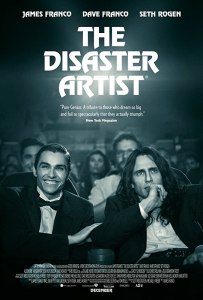
The Disaster ArtistThe Disaster Artist (synopsis; trailer; cast & crew; rated R) is the natural companion to the movie The Room; natural, because it is a movie about the making of The Room, and about the maker of that movie, the (by now legendary) Tommy Wiseau. Accordingly, I would also suggest that you read our companion discussion on The Room, as well, before – or after – perusing this one.

The movie The Disaster Artist is the brainchild of James Franco, who directed and also stars in it (as Tommy Wiseau); and it does fit his peculiar taste and sense of humor, as evidenced by other movies in which he took part – such as The Interview (a comedy about Kim Jong Un, directed by his friend, Seth Rogen, and which was the target of real-life attacks from the government of North Korea) or This Is the End (directed by Rogen, as well). In fact, Seth Rogen appears in The Disaster Artist, also – as does James Franco’s younger brother, Dave Franco. In short, The Disaster Artist can be considered as part of a “universe” (since the term has become so popular) of movies (comedies, mostly) which are made by and with – broadly – the same group of artists (although this movie, as mentioned, is specifically James Franco’s project).

As an actor, Franco does a very good job playing Tommy Wiseau; once you’ve seen The Room, you are struck by his uncanny recreation of the mannerisms (bodily, facial) and even (to a good degree) of the accent of Tommy Wiseau – and also, what is key, of the infinite awkwardness of Wiseau’s very existence (for a discussion of that see again our companion discussion on The Room). One also appreciates the care and meticulousness that went into recreating actual scenes from the movie The Room, itself (and it is a pity that not more of these scenes made in into the movie, but are only shown during the final credits).

All the other actors who, in The Disaster Artist, play the actors who were featured in the original The Room, deliver ok performances (the standard being not their acting, per se, but their capacity to recreate the other actors, from The Room). Dave Franco (James’ talented brother) also does a good job as Greg Sestero; not necessarily by producing a close imitation of Mr. Sestero (although enough of that is present), but by bringing forth quite a magnetic performance, which involves us and which holds our attention. And he needs to be able to keep our attention, because the entire story is told from the perspective of Greg Sestero (Wiseau’s friend and somewhat unwitting partner in crime), being based on Sestero’s book about his experience with making The Room.

The Disaster Artist is a comedy – and this is both good news (because both the story itself, and the movie, are actually entertaining – so it works as a comedy), but also not so good news; not so good, because at times Franco is looking for comedic “effects” (joke-like) – when, in fact, the comedic in this case does not lie in this or in that joke, but in the characters and in the human story itself. Because Wiseau himself, as a person, is a deeply comedic character (which the viewers of The Room understood instinctively, which is why they reacted so positively to it, and why it became the cult movie that it is), and so is his existence (with its essential awkwardness etc.). And the fact that he is a comedic character, as a person, does not mean that we are laughing at Wiseau, mockingly; no, there is a deep humanity in a deeply comedic character  – because, from a certain perspective or angle, we are all quite hilarious, quite laughable (in an endearing way, if you will).

This endearing dimension, of the likable humanity of these characters, is also present in The Disaster Artist; even its title expresses that – because Wiseau is both an “artist” (in his own way) and a “disaster” (as an artist). And I think that people responded well to The Disaster Artist because it was made through such a prism of understanding and empathy toward the guy – toward Tommy Wiseau; of laughing, but also of finding genuine value in the idealism and determination with which Wiseau did follow (as few do) his dreams. There is in fact a speech, at the end of the movie, from “Greg”, in which he tells Wiseau this much: “You made a movie! Do you know how few people in the world can actually say that about themselves?” There is no need, therefore, to find “jokey” moments – just let the character and the story itself reveal and express their inherent, awkward, lovable comedic nature.

But there is a deeper “failing” to this movie, as well – although the quotation marks are there because this is not actually a failing, from the point of view of what Franco intended to achieve. From my point of view, however, there is one – namely, that The Disaster Artist looks, feels, and works (structure, beats, ending) too much like a typical “Hollywood movie”. Quite ironic, isn’t it – that Wiseau did his utmost to create “the typical Hollywood movie”, and yet made a “bad movie”, that nonetheless enchants through its genuineness and its inadvertent humor; while The Disaster Artist, which purports to tell the “real story” (“based on a true story”) of The Room and of Wiseau, ends up as an idealized, Hollywood- (or VH1’s “Behind the Music”-) style product. In other words, Wiseau tore himself apart (“Lisa!!!”) to “be” Hollywood – and most amusingly failed; and then, Hollywood came for him, and made him – into Hollywood.

Instead of this “Hollywood-style” approach I would have much preferred a more realistic, grounded, deeper one – truly telling (while also underlining the humorous in it) the story of Wiseau and of The Room. For example, at the beginning of The Disaster Artist, different actors and filmmakers are asked about The Room; and one of them (Adam Scott, I believe) says that he would have loved to have been on that set of The Room, just to partake in what must have been a uniquely strange and peculiar experience. Well, recreating that experience – in all its real-ness – would have been a great idea; and, trust me, it would also have had its inherent hilarity, due to the clash between its realness – and its inherent absurdity. Instead, The Disaster Artist comes across, at the end of the day, as a “commercial-artistic” product (very Hollywood-like!) – although one made with good intentions, genuine empathy, and evident talent.

This brings to mind, though, a broader question – whether Hollywood (by which I am referring to a specific “cinematographic culture”, that has its own codes and norms of storytelling and of character-building) actually knows how to tell reality, how to depict it, as it is (whether it knows, anymore; or did it ever?). And this question is not about “making movies about real events” – that, of course, has been done, is done, and will be done, in “Hollywood”. But even if we take these movies “about real events” – we see that they are still, in fact, not “real”; instead, the story is constrained into a certain narrative straitjacket (in terms of story trajectory and structure); and the characters, instead of being flesh-and-blood, real-life people, exist and act according to our pre-existing ideas about how such characters should act and behave, in some situations. It is all quite “schematic” – which is why most people raised on this manner of story-telling and character-modelling find it really hard to even begin to make sense of  – well, more “natural” manners of storytelling and character-building. I am referring here – as counter-examples – to movies from other “cinematographic cultures” – such as, for example, Italian neo-realism (e.g. The Bycicle Thief); some of the Russian cinema (see Moscow Does not Believe in Tears, for exampleflesh-and-blood characters, if there ever was one); or the movies of a Otar Iosseliani (where one encounters life, as it is “on the streets”) or of a Nuri Bilge Ceylan (an everydayness that is also deeply poetic).

What is, then, the major difference between these narrative and character-building styles – the Hollywood-style, vs. the “natural”-style? I think that the answer lies in the fact that most of what we are, of how we behave, of how we relate as human beings – most of our very existence –  cannot in fact be expressed in words, conceptualized, schematized; and it is these unspeakable depths, this ineffable swoosh of existence, all around us, that goes missing, when narratives and characters are schematized, intellectualized, forced to fit certain mental models about how human beings should be and should behave. There is more to be said on this matter – including the fact that there is a specific value to the Hollywood narrative style (think of the fact that there is an inherent and very appealing simplicity of narrative and characters in fairytales, or in fables – no wonder Hollywood are so universally appealing) – but this is not perhaps the best place to do that; however, such a discussion is worth having, and will be had in the near future.

Returning to The Disaster Artist, we can conclude that James Franco has produced a “Hollywood version” of the Tommy Wiseau (and of The Room‘s) story; a version that is entertaining, made with heart, but also idealized and a bit formulaic. The movie is also well anchored by strong central performances  – from James Franco (an exquisite re-creation of Tommy Wiseau) and Dave Franco (who is appealing and relatable as the lead – and main perspective-giver – of the movie).

At the end of the day, I would call The Disaster Artist (not in a negative sense, but more as a way of categorizing it) a “small” movie – in terms of its sweep and ultimate ambition; and I would also call it a very entertaining, delightful, and well-made movie – and thus the perfect companion piece to the cinematographic phenomenon that was The Room.


The Room (2003)

“Tommy Wiseau is a German engineer”

TheRoomMovie

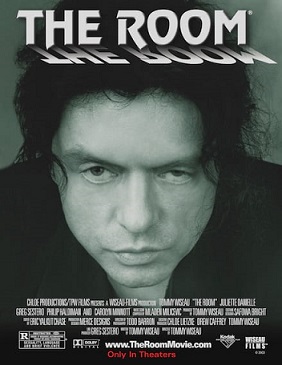
The Room (synopsis; trailercast & crew, rating), written, directed, and starring Tommy Wiseau, is a very popular movie; it has become the standard, in a way, of what a “bad movie” – or, more precisely, of a “so bad that it’s good” movie. It has even been called the worst movie of all times. Is that accurate? Of course not. Out of the hundreds of thousands of films made in over a century of cinema, around the world, this movie is clearly not the worst. Let’s just take into consideration some of the more hilarious productions from the emerging Nollywood “film industry”, or the entertainingly bad action movies coming out nowadays from Uganda, Ghana etc (I mention these examples just because they have become more prominent in the US, recently).  Every movie industry has its own lower rungs, and the lowest rungs of filmmaking are probably not even part of an “industry”; The Room, however, does not belong to that lowest rung.

One could even say that The Room is surprisingly solid from a technical point of view; just compare it with Birdemic, or with any of the Neil Breen movies. One of the reasons why this movie is competently made (from a sheer technical, albeit not artistic, point of view), is because it was crafted with the help of a professional crew, and by expending a very considerable amount of money. As described in the very entertaining movie The Disaster Artist, which documents the saga (see our companion discussion of that movie), Wiseau himself financed the movie, spending about 6 million dollars (!) on it. Well, the money he spent is visible in the decent quality of its technical execution. What, then, makes this movie so “bad”, yet also so “entertaining”?

Well, to a large degree, the answer lies with Tommy Wiseau himself, namely with him being both the creative mind behind the film (writer, director, producer), and its main protagonist (actor). Speaking of acting, one could say that the quality of the performances varies somewhat widely; there are quite a few fairly competent ones, including from Wiseau’s friend and project partner, Greg Sestero (“Mark” – nothing special, but competent); or, what I would consider the most grounded and constant performance, from Carolyn Minott (playing the mother in law, “Claudette”). There are however some noticeably poor performances, as well – really noticeable ones! – such as, for example, from the actress who plays the wife (Juliette Danielle as “Lisa”), or some of the famous scenes featuring Mike Holmes (“Mike”). But the standout (in a number of bad and strange ways) is the performance from Tommy Wiseau himself (who plays “Johnny” in the movie).

There is an ongoing mystery, that has never been solved definitively, regarding Wiseau’s ethnic origin (nationality of birth). At the end of the day, this doesn’t matter; in fact, this just adds to the mystique of the movie and of its creator. So why then the introductory statement, that “Tommy Wiseau is German”?

What sets Wiseau apart, as an actor in this movie, and even among the weaker performances, is the curious, awkward nature of his very presence within the movie. Throughout the film, there is a strange detachment exhibited by his character, in rapport with the situations in which he finds himself. Of course, he “acts”, and he “reacts”, very visibly, and sometimes loudly, as well. But, at the same time, we see and feel that the “person” (Wiseau’s personhood, in fact) remains curiously remote, and emotionally detached, in every situation; in other words, while Johnny acts, Wiseau remains uninvolved, absent even. And nothing shows this better than Wiseau’s eyes – whose expression is unchanging, inert, inscrutable, throughout the movie, and throughout the story. The eyes, this essential tool of an actor, the true window into the personality of the character, in this case reveal nothing, as if there is nobody there (or nobody there whom we could solidly grasp and see). Their expression is constant, opaque, even monotonous, while the rest of the face and of the body act and interacts in the scene… it is truly fascinating to watch.

Then, there is the awkwardness of Johnny’s reactions to the various situations, and of how he interacts with other characters – his reactions almost always managing to surprise us, which make him the most fascinating character (and actor) in the movie (!). Yes, he exhibits a strange sort of alienation (“alien” being the key word) from what would be the normal, human ways of interaction and behavior. Watching this is simultaneously mesmerizing (his performance grips and keeps your attention) as well as highly entertaining (because of the incongruity, absurdity that results).

The plot is fairly nonsensical, going this way and that, with dead-ends and unexplainable sideways; but, at the end of the day, the plot is irrelevant. It seems (like others have noted) that the script is essentially biographical, being a splattering unto the pages of a sum of Wiseau’s personal experiences and, even more dangerously, of “deep thoughts” – about life, relationships, the world –  while the main character (played of course by Wiseau) is this unimpeachable “good guy”, self-sacrificing, driven only by good intentions… Oh, it’s true drivel, exhibiting all the worst things: it’s in bad taste, puerile, sentimental, self-involved… but it is also highly entertaining, for the exact same reasons. (In these aspects, the script resembles all of Neil Breen’s productions, which exhibit the same things, only increased thousandfold.)

A lot of the details noted above are also deftly touched upon (and explained, or contextualized) in The Disaster Artist, which is why I would recommend watching these two movies back to back, as a double feature – both are highly entertaining, and they complement each other perfectly. This is why The Room fits the “so bad that it is good” category so perfectly – although it is bad, it also really gets a hold of the viewer’s attention, and never lets go; the viewer is constantly fascinated, amused, and also incredulous, at what is going on. Overall, then, the movie is highly entertaining, and comes across as fresh – which is an epithet that few Hollywood movies actually deserve.

But the salient element in this whole affair is Tommy Wiseau himself, who remains an enigma – as an actor, as an auteur, as a person. Who is he? What does he want to say to us? How aware is he, actually, of the ridiculousness of all this? It is his remoteness, the unbridgeable distance that seems to separate us from Wiseau the actor / character / author / person, that made me state at the beginning that, even if one does not actually know for sure his national origin, “Tommy Wiseau is a German Engineer”.

Yes, because the aloofness, the lack of outward emotional expression, the seemingly unpassable distance to the core of the other person – is what one encounters, when meeting Germans – and engineers. They’re strange, those creatures; they relate awkwardly to life; they seem to have a strange misapprehension – or lack of understanding – about how normal, flesh-and-blood human beings act and live; they are strangely robotic… Of course, I mean all this … only half in jest.