
“Tommy Wiseau is a German engineer”
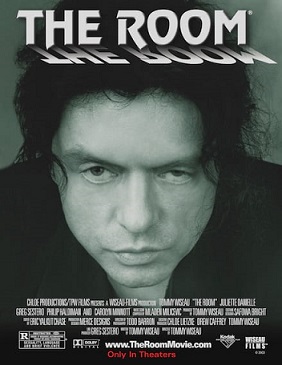
The Room (synopsis; trailer; cast & crew, rating), written, directed, and starring Tommy Wiseau, is a very popular movie; it has become the standard, in a way, of what a “bad movie” – or, more precisely, of a “so bad that it’s good” movie. It has even been called the worst movie of all times. Is that accurate? Of course not. Out of the hundreds of thousands of films made in over a century of cinema, around the world, this movie is clearly not the worst. Let’s just take into consideration some of the more hilarious productions from the emerging Nollywood “film industry”, or the entertainingly bad action movies coming out nowadays from Uganda, Ghana etc (I mention these examples just because they have become more prominent in the US, recently). Every movie industry has its own lower rungs, and the lowest rungs of filmmaking are probably not even part of an “industry”; The Room, however, does not belong to that lowest rung.
One could even say that The Room is surprisingly solid from a technical point of view; just compare it with Birdemic, or with any of the Neil Breen movies. One of the reasons why this movie is competently made (from a sheer technical, albeit not artistic, point of view), is because it was crafted with the help of a professional crew, and by expending a very considerable amount of money. As described in the very entertaining movie The Disaster Artist, which documents the saga (see our companion discussion of that movie), Wiseau himself financed the movie, spending about 6 million dollars (!) on it. Well, the money he spent is visible in the decent quality of its technical execution. What, then, makes this movie so “bad”, yet also so “entertaining”?
Well, to a large degree, the answer lies with Tommy Wiseau himself, namely with him being both the creative mind behind the film (writer, director, producer), and its main protagonist (actor). Speaking of acting, one could say that the quality of the performances varies somewhat widely; there are quite a few fairly competent ones, including from Wiseau’s friend and project partner, Greg Sestero (“Mark” – nothing special, but competent); or, what I would consider the most grounded and constant performance, from Carolyn Minott (playing the mother in law, “Claudette”). There are however some noticeably poor performances, as well – really noticeable ones! – such as, for example, from the actress who plays the wife (Juliette Danielle as “Lisa”), or some of the famous scenes featuring Mike Holmes (“Mike”). But the standout (in a number of bad and strange ways) is the performance from Tommy Wiseau himself (who plays “Johnny” in the movie).
There is an ongoing mystery, that has never been solved definitively, regarding Wiseau’s ethnic origin (nationality of birth). At the end of the day, this doesn’t matter; in fact, this just adds to the mystique of the movie and of its creator. So why then the introductory statement, that “Tommy Wiseau is German”?
What sets Wiseau apart, as an actor in this movie, and even among the weaker performances, is the curious, awkward nature of his very presence within the movie. Throughout the film, there is a strange detachment exhibited by his character, in rapport with the situations in which he finds himself. Of course, he “acts”, and he “reacts”, very visibly, and sometimes loudly, as well. But, at the same time, we see and feel that the “person” (Wiseau’s personhood, in fact) remains curiously remote, and emotionally detached, in every situation; in other words, while Johnny acts, Wiseau remains uninvolved, absent even. And nothing shows this better than Wiseau’s eyes – whose expression is unchanging, inert, inscrutable, throughout the movie, and throughout the story. The eyes, this essential tool of an actor, the true window into the personality of the character, in this case reveal nothing, as if there is nobody there (or nobody there whom we could solidly grasp and see). Their expression is constant, opaque, even monotonous, while the rest of the face and of the body act and interacts in the scene… it is truly fascinating to watch.
Then, there is the awkwardness of Johnny’s reactions to the various situations, and of how he interacts with other characters – his reactions almost always managing to surprise us, which make him the most fascinating character (and actor) in the movie (!). Yes, he exhibits a strange sort of alienation (“alien” being the key word) from what would be the normal, human ways of interaction and behavior. Watching this is simultaneously mesmerizing (his performance grips and keeps your attention) as well as highly entertaining (because of the incongruity, absurdity that results).
The plot is fairly nonsensical, going this way and that, with dead-ends and unexplainable sideways; but, at the end of the day, the plot is irrelevant. It seems (like others have noted) that the script is essentially biographical, being a splattering unto the pages of a sum of Wiseau’s personal experiences and, even more dangerously, of “deep thoughts” – about life, relationships, the world – while the main character (played of course by Wiseau) is this unimpeachable “good guy”, self-sacrificing, driven only by good intentions… Oh, it’s true drivel, exhibiting all the worst things: it’s in bad taste, puerile, sentimental, self-involved… but it is also highly entertaining, for the exact same reasons. (In these aspects, the script resembles all of Neil Breen’s productions, which exhibit the same things, only increased thousandfold.)
A lot of the details noted above are also deftly touched upon (and explained, or contextualized) in The Disaster Artist, which is why I would recommend watching these two movies back to back, as a double feature – both are highly entertaining, and they complement each other perfectly. This is why The Room fits the “so bad that it is good” category so perfectly – although it is bad, it also really gets a hold of the viewer’s attention, and never lets go; the viewer is constantly fascinated, amused, and also incredulous, at what is going on. Overall, then, the movie is highly entertaining, and comes across as fresh – which is an epithet that few Hollywood movies actually deserve.
But the salient element in this whole affair is Tommy Wiseau himself, who remains an enigma – as an actor, as an auteur, as a person. Who is he? What does he want to say to us? How aware is he, actually, of the ridiculousness of all this? It is his remoteness, the unbridgeable distance that seems to separate us from Wiseau the actor / character / author / person, that made me state at the beginning that, even if one does not actually know for sure his national origin, “Tommy Wiseau is a German Engineer”.
Yes, because the aloofness, the lack of outward emotional expression, the seemingly unpassable distance to the core of the other person – is what one encounters, when meeting Germans – and engineers. They’re strange, those creatures; they relate awkwardly to life; they seem to have a strange misapprehension – or lack of understanding – about how normal, flesh-and-blood human beings act and live; they are strangely robotic… Of course, I mean all this … only half in jest.
 AFTERFILM