
“Hollywood comes for Mr. Wiseau”
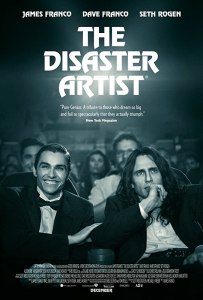 The Disaster Artist (synopsis; trailer; cast & crew; rated R) is the natural companion to the movie The Room; natural, because it is a movie about the making of The Room, and about the maker of that movie, the (by now legendary) Tommy Wiseau. Accordingly, I would also suggest that you read our companion discussion on The Room, as well, before – or after – perusing this one.
The movie The Disaster Artist is the brainchild of James Franco, who directed and also stars in it (as Tommy Wiseau); and it does fit his peculiar taste and sense of humor, as evidenced by other movies in which he took part – such as The Interview (a comedy about Kim Jong Un, directed by his friend, Seth Rogen, and which was the target of real-life attacks from the government of North Korea) or This Is the End (directed by Rogen, as well). In fact, Seth Rogen appears in The Disaster Artist, also – as does James Franco’s younger brother, Dave Franco. In short, The Disaster Artist can be considered as part of a “universe” (since the term has become so popular) of movies (comedies, mostly) which are made by and with – broadly – the same group of artists (although this movie, as mentioned, is specifically James Franco’s project).
As an actor, Franco does a very good job playing Tommy Wiseau; once you’ve seen The Room, you are struck by his uncanny recreation of the mannerisms (bodily, facial) and even (to a good degree) of the accent of Tommy Wiseau – and also, what is key, of the infinite awkwardness of Wiseau’s very existence (for a discussion of that see again our companion discussion on The Room). One also appreciates the care and meticulousness that went into recreating actual scenes from the movie The Room, itself (and it is a pity that not more of these scenes made in into the movie, but are only shown during the final credits).
All the other actors who, in The Disaster Artist, play the actors who were featured in the original The Room, deliver ok performances (the standard being not their acting, per se, but their capacity to recreate the other actors, from The Room). Dave Franco (James’ talented brother) also does a good job as Greg Sestero; not necessarily by producing a close imitation of Mr. Sestero (although enough of that is present), but by bringing forth quite a magnetic performance, which involves us and which holds our attention. And he needs to be able to keep our attention, because the entire story is told from the perspective of Greg Sestero (Wiseau’s friend and somewhat unwitting partner in crime), being based on Sestero’s book about his experience with making The Room.
The Disaster Artist is a comedy – and this is both good news (because both the story itself, and the movie, are actually entertaining – so it works as a comedy), but also not so good news; not so good, because at times Franco is looking for comedic “effects” (joke-like) – when, in fact, the comedic in this case does not lie in this or in that joke, but in the characters and in the human story itself. Because Wiseau himself, as a person, is a deeply comedic character (which the viewers of The Room understood instinctively, which is why they reacted so positively to it, and why it became the cult movie that it is), and so is his existence (with its essential awkwardness etc.). And the fact that he is a comedic character, as a person, does not mean that we are laughing at Wiseau, mockingly; no, there is a deep humanity in a deeply comedic character – because, from a certain perspective or angle, we are all quite hilarious, quite laughable (in an endearing way, if you will).
This endearing dimension, of the likable humanity of these characters, is also present in The Disaster Artist; even its title expresses that – because Wiseau is both an “artist” (in his own way) and a “disaster” (as an artist). And I think that people responded well to The Disaster Artist because it was made through such a prism of understanding and empathy toward the guy – toward Tommy Wiseau; of laughing, but also of finding genuine value in the idealism and determination with which Wiseau did follow (as few do) his dreams. There is in fact a speech, at the end of the movie, from “Greg”, in which he tells Wiseau this much: “You made a movie! Do you know how few people in the world can actually say that about themselves?” There is no need, therefore, to find “jokey” moments – just let the character and the story itself reveal and express their inherent, awkward, lovable comedic nature.
But there is a deeper “failing” to this movie, as well – although the quotation marks are there because this is not actually a failing, from the point of view of what Franco intended to achieve. From my point of view, however, there is one – namely, that The Disaster Artist looks, feels, and works (structure, beats, ending) too much like a typical “Hollywood movie”. Quite ironic, isn’t it – that Wiseau did his utmost to create “the typical Hollywood movie”, and yet made a “bad movie”, that nonetheless enchants through its genuineness and its inadvertent humor; while The Disaster Artist, which purports to tell the “real story” (“based on a true story”) of The Room and of Wiseau, ends up as an idealized, Hollywood- (or VH1’s “Behind the Music”-) style product. In other words, Wiseau tore himself apart (“Lisa!!!”) to “be” Hollywood – and most amusingly failed; and then, Hollywood came for him, and made him – into Hollywood.
Instead of this “Hollywood-style” approach I would have much preferred a more realistic, grounded, deeper one – truly telling (while also underlining the humorous in it) the story of Wiseau and of The Room. For example, at the beginning of The Disaster Artist, different actors and filmmakers are asked about The Room; and one of them (Adam Scott, I believe) says that he would have loved to have been on that set of The Room, just to partake in what must have been a uniquely strange and peculiar experience. Well, recreating that experience – in all its real-ness – would have been a great idea; and, trust me, it would also have had its inherent hilarity, due to the clash between its realness – and its inherent absurdity. Instead, The Disaster Artist comes across, at the end of the day, as a “commercial-artistic” product (very Hollywood-like!) – although one made with good intentions, genuine empathy, and evident talent.
This brings to mind, though, a broader question – whether Hollywood (by which I am referring to a specific “cinematographic culture”, that has its own codes and norms of storytelling and of character-building) actually knows how to tell reality, how to depict it, as it is (whether it knows, anymore; or did it ever?). And this question is not about “making movies about real events” – that, of course, has been done, is done, and will be done, in “Hollywood”. But even if we take these movies “about real events” – we see that they are still, in fact, not “real”; instead, the story is constrained into a certain narrative straitjacket (in terms of story trajectory and structure); and the characters, instead of being flesh-and-blood, real-life people, exist and act according to our pre-existing ideas about how such characters should act and behave, in some situations. It is all quite “schematic” – which is why most people raised on this manner of story-telling and character-modelling find it really hard to even begin to make sense of – well, more “natural” manners of storytelling and character-building. I am referring here – as counter-examples – to movies from other “cinematographic cultures” – such as, for example, Italian neo-realism (e.g. The Bycicle Thief); some of the Russian cinema (see Moscow Does not Believe in Tears, for example – flesh-and-blood characters, if there ever was one); or the movies of a Otar Iosseliani (where one encounters life, as it is “on the streets”) or of a Nuri Bilge Ceylan (an everydayness that is also deeply poetic).
What is, then, the major difference between these narrative and character-building styles – the Hollywood-style, vs. the “natural”-style? I think that the answer lies in the fact that most of what we are, of how we behave, of how we relate as human beings – most of our very existence – cannot in fact be expressed in words, conceptualized, schematized; and it is these unspeakable depths, this ineffable swoosh of existence, all around us, that goes missing, when narratives and characters are schematized, intellectualized, forced to fit certain mental models about how human beings should be and should behave. There is more to be said on this matter – including the fact that there is a specific value to the Hollywood narrative style (think of the fact that there is an inherent and very appealing simplicity of narrative and characters in fairytales, or in fables – no wonder Hollywood are so universally appealing) – but this is not perhaps the best place to do that; however, such a discussion is worth having, and will be had in the near future.
Returning to The Disaster Artist, we can conclude that James Franco has produced a “Hollywood version” of the Tommy Wiseau (and of The Room‘s) story; a version that is entertaining, made with heart, but also idealized and a bit formulaic. The movie is also well anchored by strong central performances – from James Franco (an exquisite re-creation of Tommy Wiseau) and Dave Franco (who is appealing and relatable as the lead – and main perspective-giver – of the movie).
At the end of the day, I would call The Disaster Artist (not in a negative sense, but more as a way of categorizing it) a “small” movie – in terms of its sweep and ultimate ambition; and I would also call it a very entertaining, delightful, and well-made movie – and thus the perfect companion piece to the cinematographic phenomenon that was The Room.
 AFTERFILM